
Bookbinding Thread and Needles
Where does linen come from?
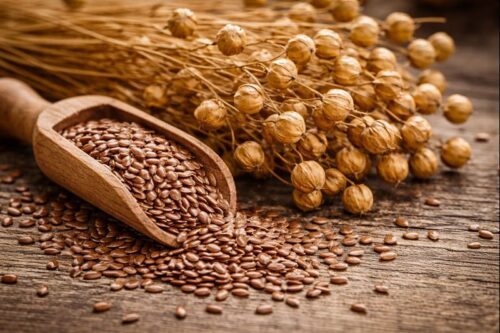
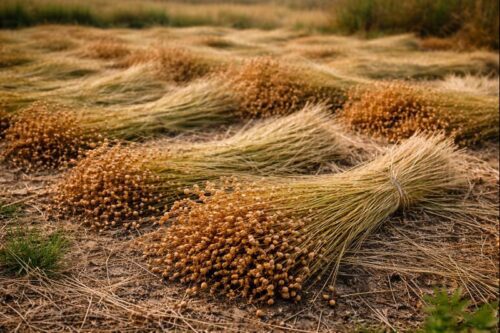
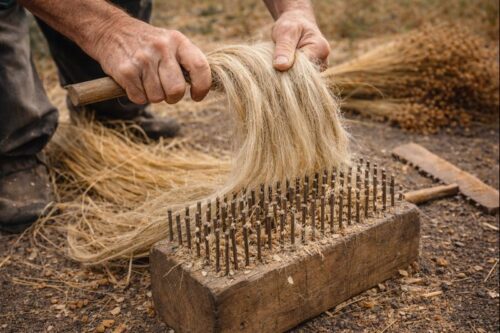
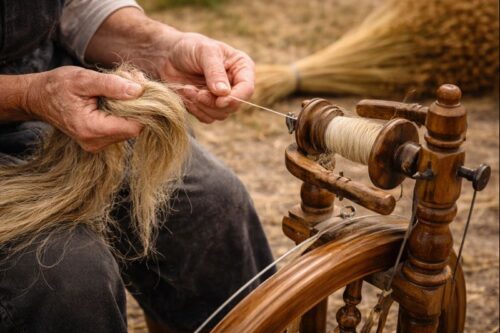
Linen comes from the flax plant. Flax fibers are long, strong, and naturally shiny, with a soft, beautiful sheen. When the flax fibers are ready to be spun into thread, they are called line flax. Line flax comes in lovely natural shades such as cream, tan, silver, and grey. Like all natural fibers, flax comes in different qualities too — some fibers are coarser, while others are finer, and their colours can vary.
Our linen thread is spun locally from flax fiber using traditional methods. It is wet-spun with an S-twist. What does that mean?
To make smooth, strong, and even thread, the flax needs to be spun while damp. Wetting the fiber helps the loose ends settle down and creates a smoother thread. We use a flax-seed solution for this process. An S-twist simply means the thread is twisted to the left, which is the natural direction flax fibers prefer and the traditional way linen has always been spun.
Once the flax has been spun, it officially becomes linen thread — a small but magical change in name!
Our linen threads come in different weights, meaning the thickness of a single strand can vary. Some strands are thick enough on their own, while others are paired with similar strands to achieve the right strength and size.
After pairing, the strands are plied together using an S-twist again. To keep things simple, we offer just four thread sizes.
Once plied, the thread is washed (scoured) and the twist is set under gentle tension. Scouring cleans and softens the thread and lightens its colour slightly, but linen will never become pure white naturally. Instead, you get beautiful natural whites, silvery whites, and grey-whites. Our bright white thread is dyed, not bleached. Unbleached linen thread is completely natural and has not been treated with harsh chemicals.
Bookbinders have traditionally used linen thread because it is strong, pleasant to work with, and long-lasting. It is soft, slightly squishable, absorbent, and has a lovely natural sheen — making it perfect for hand bookbinding.
What size thread should you buy?
Use a thread size according to the thickness of your paper. A No1. thread is perfectly fine for 80gsm bond paper.
The thicker the thread, the bulkier the spine of your book will be.
Thread Calculators

Coptic Binding
Coptic binding is a traditional technique in which signatures (folded groups of pages) are sewn together through their folds and linked with chain-like stitches across the spine. You don’t use glue — the stitching is both decorative and functional.
It’s commonly used for:
- sketchbooks
- art journals
- any book that needs to open fllat
With Coptic stitch, the thread passes through the signatures and wraps in a linked pattern that forms a kind of chain down the spine — you can see the individual stitches clearly on the outside of the book.

Saddle Stitched Binding
Saddle stitch (also called pamphlet stitch) is one of the simplest bookbinding techniques:
You fold your pages in half
Punch 3–7 holes along the fold
Sew through the fold with one continuous thread
It works especially well for:
✔ small booklets
✔ zines
✔ magazines
✔ brochures
✔ pamphlets
✔ thin artbooks
Because the pages are folded and sewn along the spine, the book:
opens flat
lies cleanly
has visible stitches along the fold

Kettle Stitch Binding
Kettle stitch binding is a traditional bookbinding method used to sew folded groups of pages (called signatures) together into a strong text block.
The pages are stitched through their folds, and each signature is linked to the next one with small locking stitches at the top and bottom of the spine, called kettle stitches.
This method creates a flexible but secure spine and is commonly used for hardback books, journals, and handmade notebooks.
Kettle stitch binding allows the book to open well while keeping the pages firmly attached, making it one of the most durable and time-tested sewing techniques in bookbinding.
Kettle stitch is commonly used for:
✔ case-bound books
✔ hardcovers
✔ journals sewn in signatures
✔ traditional hand binding
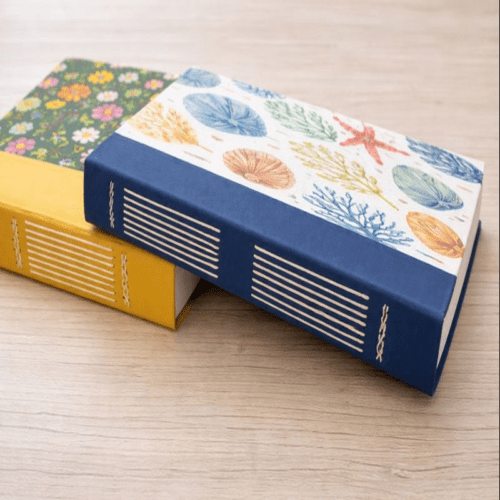
Long Stitch Binding
Long stitch binding is a traditional sewing method where signatures are stitched directly to the cover using long, visible stitches along the spine. It is strong, flexible, and decorative, and is often used for handmade journals, sketchbooks, and medieval-style bindings. The exposed stitching makes it both functional and part of the design.
- The book is sewn through holes in the cover and signatures
- The thread makes long vertical stitches on the outside
- The spine is exposed and decorative
- No glue is needed to hold the book together
Coptic Stitch Thread Calculator
Estimate how much thread you need for Coptic stitch binding. Measurements in cm.
Saddle Stitch Thread Calculator
Estimate how much thread you need for saddle stitch / pamphlet stitch. Measurements in cm.
Kettle Stitch Thread Calculator
Estimate how much thread you need for sewing signatures with kettle stitch. Measurements in cm.
Long Stitch Thread Calculator
Estimate how much thread you need for long stitch binding. Measurements in cm.



DIY Book Binding Supplies
Contact Us.
Email: info@diybookbindingsupplies.co.za
Address: 55 Dunville Road, Grosvenor, Bluff, Durban, South Africa, 4052
Sunday: Closed
Monday: 10:00am–17:00pm
Tuesday: 8:00am–17:00pm
Wednesday: 8:00am–17:00pm
Thursday: 8:00am–17:00pm
Friday: 8:00am–17:00pm
Saturday: Closed
“Made for bookbinders, artists, and lovers of handmade books.”
Have a query?
Bookbinding thread and needles for hand-sewn books
Strong thread and the right needle make hand binding easier, neater and more durable. This range is useful for Japanese stab binding, pamphlet stitching, exposed-spine journals and book repair projects.
Choose thread that suits the thickness of your book and the look you want on the spine. Waxed linen thread is a reliable option when you want grip, strength and visible stitching.
Helpful questions
What thread should I use for bookbinding?
Waxed linen thread is a popular choice because it is strong, easy to control and holds stitching tension well.
Can I use normal sewing thread for bookbinding?
Normal sewing thread can work for very small paper projects, but stronger bookbinding thread is better for journals, notebooks and exposed spine bindings.
Do I need special needles for bookbinding?
A sturdy needle that suits your thread thickness makes binding easier and helps prevent fraying, snagging and uneven stitches.